

A Picture is Worth a Thousand Words - Completed!
- Marjorie

- Oct 26, 2019
- 3 min read
Updated: Oct 30, 2019

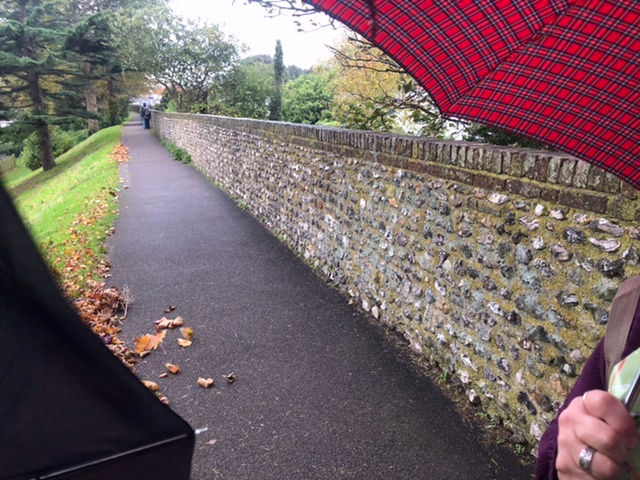
Here we are in the wonderful little city of Chichester. Yes, little and city do go together. Here a place that has a cathedral in it is a city, regardless of its size. Chichester is full of history. The centre of the city is completely surrounded by a massive Roman wall. The very imposing wall is still in great condition. The walls are 7 metres (23 feet) tall on the outside. Inside the walls are much shorter, the ground was probably pushed up against them to allow guards access to the top of the wall.

There are four gates, north, east, south, and west, through which the Roman roads passed.

In the centre of town, where the roads meet, is the market cross. Built by the cathedral’s bishop, it was finished in 1503. The architecture is the late English perpendicular style, the main feature of which is the long vertical lines which are more noticeable in church and cathedral windows. Market crosses were the gathering place for anyone with something to sell on market days.
Chichester Cathedral is small but mighty.


It was built on the grounds of a monastery built in 681 by St Wilfred, who was presumably not a saint at that time. Building the cathedral was begun in 1076 by the Normans, and dedicated in 1108. The early fifteenth century saw the building of the spire and bell tower, the only bell tower not to be attached to the cathedral building. Then in 1861 the spire collapsed and was rebuild by the Victorians.

In the 1530’s Bishop Robert Sherburne commissioned a painting on a very grand scale. Measuring 14 feet tall and 32 feet wide the painting is amazing. Unfortunately I cannot remember or find out about the scene on the left other than that the fellow with a white cap behind the shoulder of the main man in gold is the artist, Lambert Barnard.

The central panel, shown at the top of this post, features King Henry VIII granting Bishop Sherburne and the cathedral clemency. In it we see a glimpse of Henry’s Court, with Anne Boleyn’s father on the far left in red. The third face from the left, the man in blue, is Sir Thomas More who was Henry‘s Chancellor. With his arms spread in a welcoming posture is Henry and the man facing him is Bishop Robert Sherburne. The Bishop is shown in support of Henry’s bid for an annulment of his marriage to his first wife Catherine of Aragon so that he could marry Anne Boleyn. Whether he actually was is not something that I have not been able to find, but his obeisance in this painting is possibly the reason he lived and Sir Thomas More did not. (When Henry broke from the Catholic Church and formed the Church of England Sir Thomas More refused to support the break. More then refused to swear his allegiance to the Act of Succession creating Anne Queen. Consequently, he lost his head.)

Also part of the painting are portraits of the Kings of England. One young King’s image had his eyes poked out by the Puritans during the destruction of the Reformation.
In the cathedral of particular interest to me is the memorial stone for English composer Gustav Holst. You may know of his most famous (and his least favourite) composition ‘The Planets.

An example of the destruction done during the Reformation is this hole where statues or other decorations were located that the Puritans felt were too excessive:


A metre below Chichester is the old Roman town of Noviomagnus Reginorum. This small floor mosaic sits under the floor of the cathedral exposed by a piece of clear flooring. Note the pattern on the far right. Its beauty may have been destroyed by the Nazis, it shines on in the ancient cultures of Rome and China.


For my St Olaf family and friends:

Thank you for your patience while I completed this post!

Comments