

Roman Forum & Colosseum!
- Marjorie Monroe-Fischer
- Dec 11, 2025
- 9 min read
I thought Herculaneum was exciting, and it truly was. But Tuesday, with the major Roman ruins in Roma was nothing short of amazing!!! Yes, I keep using that word, but it is the one that truly describes my thoughts.
Tuesday we were scheduled to tour the Foro Romano and Colosseo with an archaeologist. I had found out that such a tour was possible, so thought that it was worth the extra money. Was it ever! The day was to begin at 10:00 at the furthest part of the Foro from our flat. I discovered on our excellent map that we would be very close to one of my absolute must sees, the Trajan Column. Those of you who are not calligraphers probably are wondering what in the world is so important about a column. There must be hundreds, and there are. But this one is special. At the base is a dedication to Trajan, the Roman emperor from 98 to 117 CE. When someone wanted to express how wonderful they were, or those that came after wanted to honour them, a column was erected with their name on it. Very helpful for archaeologists and historians. Trajan’s column is huge, with the dedication at the base. It is known to calligraphers worldwide as the greatest (one of them anyway) example of the new letters - what we call Roman Capitals. I have even seen and photographed an original rubbing of the inscription by the famed scribe, Father Edward Catich. A rare opportunity.

These letters, and, for the most part, their spacing, is considered virtually perfect, and the goal for truly serious calligraphers. Most work on these for their entire careers. I can draw them, but making them as well as I like with a pen or brush - I am far from proficient. I will work on these forever and never be happy with them!
We arrived at the correct location according to Apple Maps’ directions. Some people asked for their photo to be taken, which Glenn took. I turned around and there it was, looming over me. It is utterly huge!

The tale of his most famous battle is wrapped around the column, with his statue adorning the top. I was confused that I could not see the inscription. It was getting to be time to meet our archaeologist guide, so I put the address into maps and pulled up the directions. We walked down the steps, walked a couple of yards, and she said that we had arrived! I sent our guide Paola a message that we had arrived and were in the shadow of the column. No guide. We waited. It was a few minutes after 10:00 when I received a message ‘Are you here? Where are you?’ Just like the day before, there were too many apps in which we had corresponded. It seemed that she and the other 2 people on our tour were right where we had stopped to see the column. Introductions were made, an overview of what we would be seeing was given, and lo and behold, we went right down to the base of the column! There I could see the inscription, but we walked right past it before we stopped for her explanation. As she finished I excused myself briefly and headed quickly back to the closest place that we were allowed to get to the inscription. It was a gloriously sunny day, and the sun was shining directly on that side of the column.

This was the best picture that I could get. If I had not had to run back to our group I would have cried. Oh well, I was there.
Moving along, Paola would stop every several yards within this huge site to explain what we were seeing.

Here is a temple built in honour of the Devine Emperor Antonino and his Devine Empress Augustina. But the building inside of the columns is not Roman! When the Christians came this part of the city had been abandoned. Here, and in many similar places, they saw the perfect place to make a church. So they took the marble from the inside of the temple and built their church. But, they did not want the columns in front of their church, a symbol of the heathen gods worshiped by the Romans. If you look towards the top of these columns you see some lines digging into the marble where they attempted to pull them down. They had no idea what they were attempting! As you can see, they were thankfully unsuccessful.

Restorations are everywhere. They are always made as a different colour than the original so that the original can be identified. These three columns are some of the only completely original columns in the Forum. On the furthest column in the bottom section, if you enlarge the photo, you can almost make out a bit of green. The Romans used bronze to brace their building. You can see holes in many, many structures. This is where, like legos, the marble façade was put on top of the stone and bronze. Thus we know that these are entirely original. Truly amazing as so much of the site was razed over the years, especially by Mussolini. He wanted to compare himself to the emperors of old, so he both excavated and restored some of the site, but also built a huge road on top of it as well as a grand building to glorify himself.

This is just a fraction of the building which has a huge crescent structure between this and an identical protrusion. Very austentation. Of course it was built on the Palentine hill, the one hill of the 7 of Romulus’ original Rome, where all emperors built their palaces. Extremely prestigious.
On to the Forum. Throughout the site you can see where the builders during the Middle Ages took advantage of the buildings and the building materials. This grand edifice is Roman up through the arches, and mediaevel above.

Here you see part of a medieval house, and below it a wall where you can see pieces of the original marble used amongst the stone.


The Basilica of St. Peter in the Vatican is built at least in part with marble from these ancient Roman buildings.

Here you see the courtyard and walls of the home of the Vestal Virgins. Their job was to keep the sacred flame burning in the Pantheon (which we did not visit). It was thought that if the flame was extinguished Rome would fall. The Vestal Virgins were perfect young women inside and out, usually daughters of Senators or other nobles. They had to keep themselves perfectly pure to be worthy of this solemn task. They retired when they were about 30, at which time they could have a personal relationship. However, at that time of life during this era women could no longer give birth, so basically, they had no life as it was seen in that period. You see below the statues of the Virgins surrounding the courtyard. Notice that most have no heads. Once a Virgin retired the head of her statue was removed and a new head, that of her replacement, was fastened atop the body. No sense wasting a good statue!
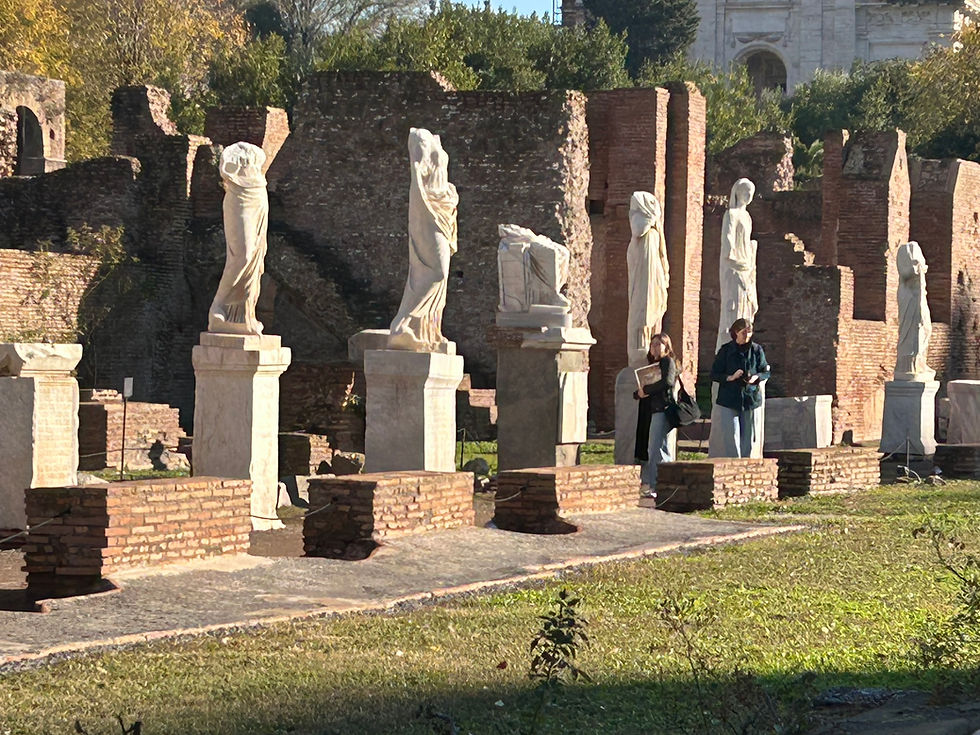
Studying these statues is how we know that they dressed, wore their hair, and much about their daily lives.

Here you see part of the palace of, if I remember correctly, the emperor Nero. He was pretty crazy to begin with, but by the end of his life he went completely insane. He wanted to make his palace on the Palatine hill larger than the space available, so he built the hill up to support a larger structure!

Unlike the thought that Nero fiddled while Rome burned, he actually loved his people and did much to help them during and after this horrible event.
I have many, many more pictures, but let’s move on to Rome’s most famous building.

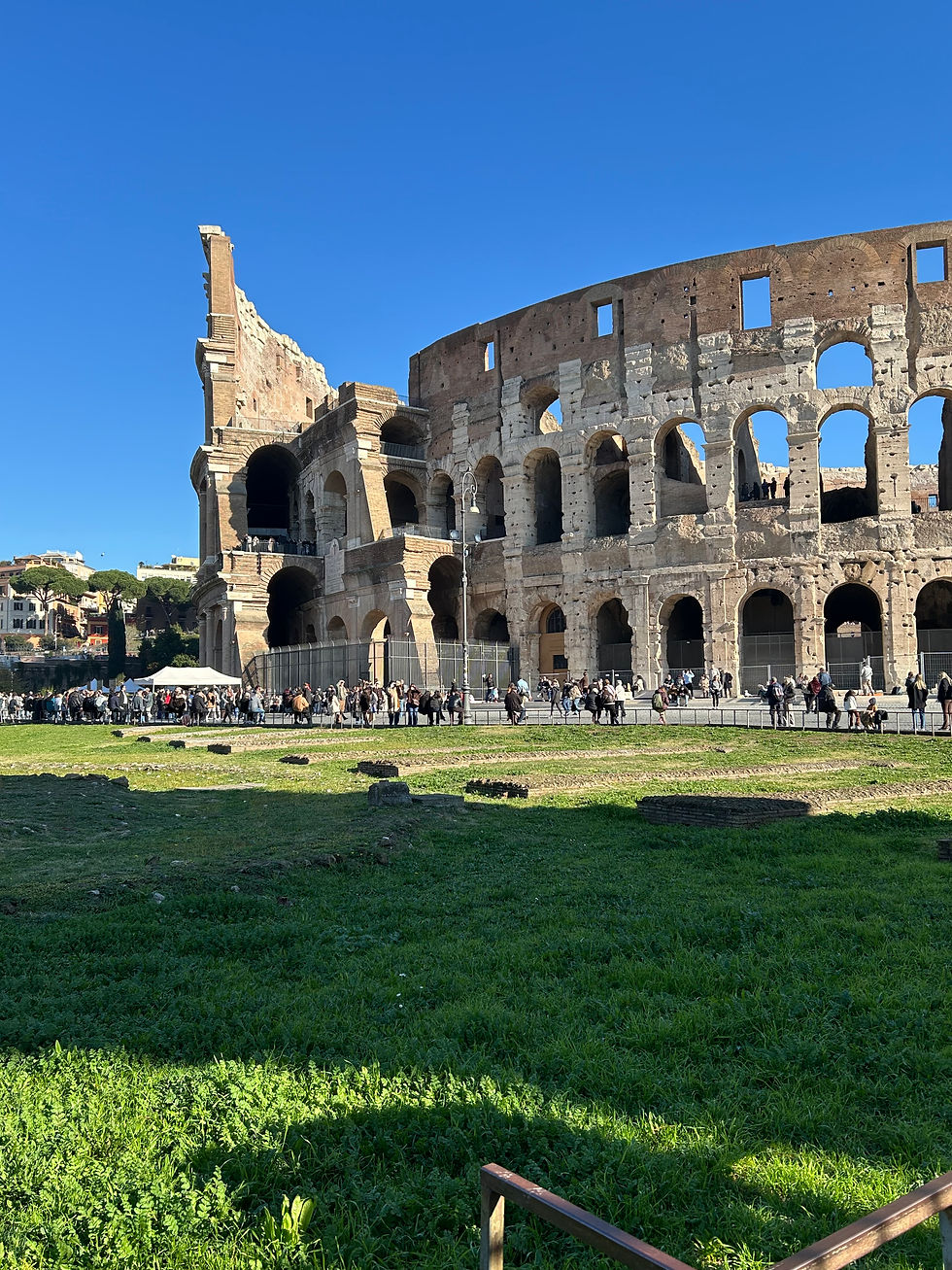
Following the horrible reign of Nero there were 4 emperors who did not make life better for the Empire. It was felt that a new family should reign. So, with Vespasian began the Flavian dynasty, and much more stability. To placate the populace one of Nero’s artificial lakes was drained and the Colosseum built. As you know, it was the site of the games, when gladiators fought exotic wild beasts as well as each other. These games were free to the people, even with free food. They had tickets which not only told them which gate they were to enter, it also told them which seat they were assigned! The Senators had their names engraved on their seats. Nice to be in charge! If you look hard, at the top of these arches you will see the Roman numerals designating which gate it is. This is the outermost wall of the Colosseum. If you look at the photo at the top of this post you will see the wall in the photo above with the gates being numbered. Then there is another set of arches, and finally, what remains around most of the building, the inner wall.
In the above photo, the second level of arches would be the second level of seating, and on up to the third level. Above that would have been open space for the women. 😡 They may have been able to sit in the top level of seats, but with my hearing and the sound of the crowd I missed things. The wives of the Senators and other important people could sit with their husbands.
At the very top you see a lip sticking out with regular holes. That was for the ropes which supported the cloth covering for all in attendance. Here is a depiction of what the inside of the Colosseum would have looked like, with the red being the roof which was held in place with ropes all day by sailors. Who else could understand sails?

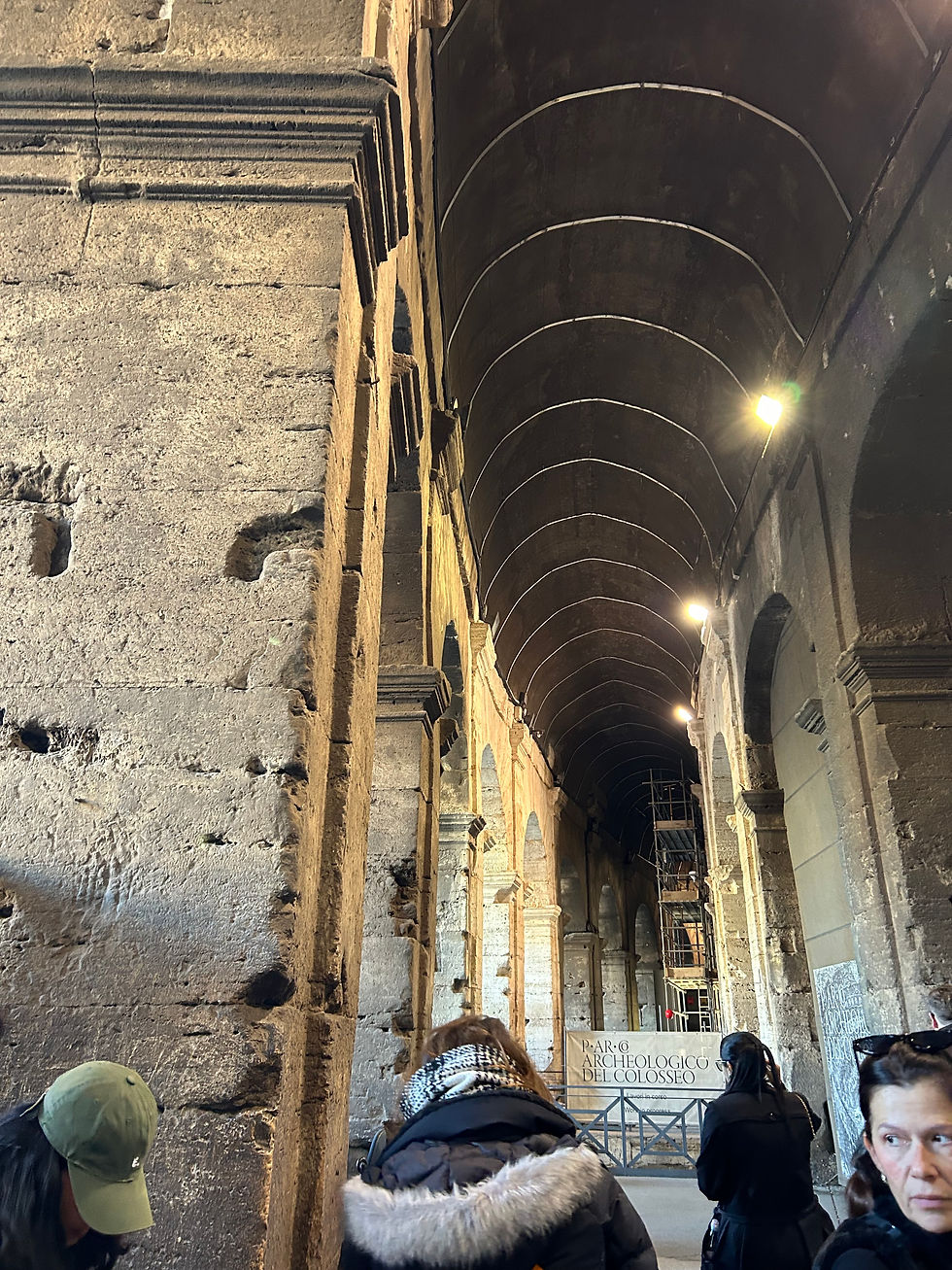
This is what they saw once through the gate. Notice the holes in the wall where the marble was attached. In here you would find all sorts of things, even animals. Paola showed us the holes where the animals were tied up. They were even at different heights for different sized animals!

This one would be for a tall animal, a horse perhaps?
A brief aside - Paola, above, is what you think of as the typical Italian. She talks at warp speed, and uses her entire body constantly to express what she is saying. I would have taken a video if I wasn’t concerned about my camera running out of power, which it did.
As you can probably tell from the photo above the hole in the column, the above floor is a heck of a long way up! I am very grateful that they have installed the modern convenience to a lift!!!
Once on the next ‘floor’ you can look out over the entire inside of the structure.

We are on the second level of arches, not counting the bottom arches which would be below the floor which is depicted on the right. What looks like a slanted roof over the two visible seating areas is actually the floor of the seating area. To the right of centre on the level of the floor, which was made of wood covered with sand because it absorbs the blood, you see three arches with an open area above. That was where the emperor would have entered. The odd thing is that the side with his entry is in sun all day long, where as the side where I am standing is in shade all day. Consequently, he and his family must have had a box on the shady side as sitting in the sun all day, even with the shade, must have been excruciatingly hot.
What you see below where the floor would have been is where the locally found animals for the morning’s hunting sport and the exotic animals for the gladiators to fight would have had pens, and the gladiators would have awaited their entrance following lunch. In the floor were 36 trap doors with 80 shafts with stairs and elevators for the animals and gladiators to arrive in the arena. The Colosseum is an amphitheatre, which means two theatres back to back. What the people came to see was theatre. The first appearance of the gladiators would be from the large arches on the far left where they would arrive parading in chariots. Opposite those arches are an identical set, through which those very few gladiators who died in the arena would depart. Possibly the seriously wounded as well, but again, my hearing… Have you seen the film ‘Gladiator’ with Russell Crowe? Even Paola said that everyone should watch it as it is a very good, mostly true depiction. However, in real life, the intention was that all of the gladiators would live in spite of their inevitable wounds. Some died under care afterwards, but extremely few died in the arena. The person who would have ruled that the winner lived or died was not the emperor but the owner/trainer of the gladiators. So much work was put into their training and the cult of their existence, which Paola compared to people like Michael Jordan, that they never called for the winner to die. The hand symbol was not as depicted in the film with thumb up or down, but to live was a fist with the thumb inside showing protection, or the thumb sticking out to the side like a sword ready to slit his throat.
Also, in spite of what the church has told us for centuries, no Christians died in the arena. The era of Christians in Rome was after the era of the games.
Our tour ended at 1:00. The plan was to find a trattoria for lunch on the walk back to the flat. The walk was listed at 15 minutes, but we were both really dragging! I had us walk quite a ways from the Colosseum to get away from the obvious tourist spots. We found a nice place, had a tasty lunch, and then trudged back, arriving barely able to walk! It is a really good thing that nothing is scheduled for Wednesday!
This has been a long read, so I will leave you here:

Note: On top of Trajan’s column is no longer a statue of Trajan. He was replaced by one of the popes with a statue of St. Peter, the patron saint of the Vatican.


Comments