

Castles!
- Marjorie

- Oct 22, 2019
- 3 min read

English castles are not the fairytale castles that we might think of from Disney, like the famous Neuschwanstein Castle in Bavaria, Germany.

These English castles were built for defense from outside invasion and from inside squabbles. Frequently they were so impenetrable that the only way of winning over the inhabitants was to starve them out.
Bodiam, the quintessential English castle. Bodiam was built with permission from King Richard II from 1380-1385 by Sir Edward Dallingridge and his wife Elizabeth. Having spent much time fighting in France, Edward amassed a fortune and wished to build a castle where he could live in luxury. The license reads
’that he may strengthen with a wall of stone and lime, and crenellate and may construct and make into a castle his manor house of Bodyham, near the sea, in the County of Sussex, for the defence of the adjacent country, and the resistance to our enemies...’
Although it was built for their home, it was built with all of the requisite defence features. The outside is amazingly preserved, complete with a large moat and an intact portcullis. The wood in the portcullis has been carbon dated to the 14th century, an amazing length of survival for wood.


The entrance would have had three portcullises to catch any invaders between. Overhead in the vaulted roof are ‘murder holes where boiling water, boiling oil, stones or lime would have been dropped. Presumably anyone caught would be looking up, hearing something above, and lime, made from the ground droppings of birds kept in a dovecote, would blind them and burn their lungs. Lovely. Apparently these defences were never required during Sir Edward’s time.
The inside of the castle has deteriorated, but the general layout is still quite visible.


Hastings Castle is a ruin on the highest spot at Hastings. It was built in the perfect place to watch over the English Channel for an invasion from France. An original motte and bailey castle, it was hastily erected in wood by William the Conqueror, and then soon replaced by stone.

Behind us is a narrow, deep valley making castle access very difficult. A perfect location.
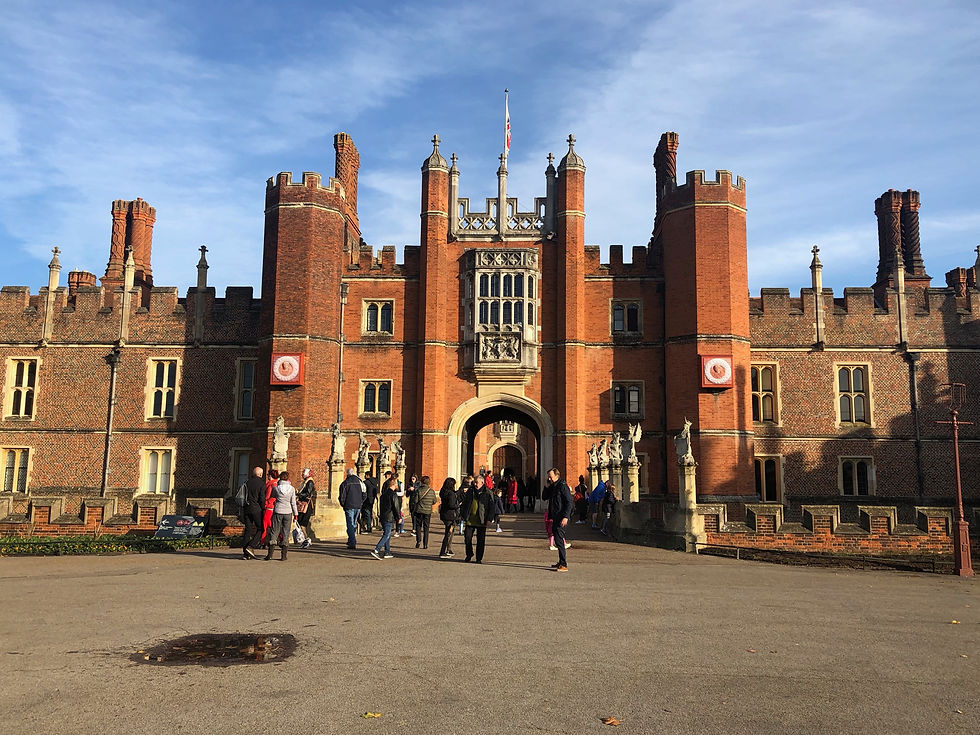
Herstmonceux Castle, a Tudor castle, is the first brick building in Britain. Sir Roger Fiennes, who won favour fighting in France with King Henry V and his son King Henry VI, owned both Hever Castle and a Manor House at Herstmonceux. In 1441 he applied to build a castle on the site ‘With walls and lime, enclose, krenellate, entower and embattled his manor of Hurst Monceux.’ As no English people knew how to lay bricks they brought bricklayers over from Holland. Herstmonceux is a bit of an odd duck as the interior was completely destroyed, leaving only the outer walls. It has since been rebuilt in the Tudor style, but the inside is quite modern as it is owned and used by Queen’s University, Canada.


Pevensey, where Duke William of Normandy landed, has an amazing castle. The huge outer ring is Roman. The outside is mostly intact, but the inside of the wall has been scavenged for building the interior castles.

Here you can see the size of the whole castle: the outer ring of the Roman fort, called Anderida, and the medieval Bailey at the bottom. The gate through which we entered is at the bottom right.


The Roman fort of Anderida was built in 290 CE as a costal defence. It was one of nine forts along the ‘Saxon Shore.’ The ‘Anglo Saxon Chronicle’ records that it was under siege in 491, and its residents were killed by a Saxon army.
On 28 September William, Duke of Normandy, arrived with his invading army. They immediately built a wooden fortification, no doubt within the walls of the Roman fort. The following day they marched towards Hastings and towards his victory over King Harold. In 1067 after securing the throne of England he returned to Normandy for a celebratory tour, but before leaving gave the land and the castle to his half-brother Robert. It was probably Robert who erected a permanent stone Keep on the site. In 1088, not satisfied with his lot, he attempted to take the Crown from William the Conqueror’s son, King William Rufus. After a six-week siege he and his men were starved out. From then on ownership of Pevensey went back and forth from the Crown. It was recorded as being destroyed and rebuilt many times. During Tudor times it was completely neglected, but partly restored by Elizabeth during the threat of the Spanish Armada. One cannon from that period survives. In World War II its strategic location made it again useful. The English built pillboxes for defence within the walls of the Keep, maintaining the look of the old ruins. They also modernised some enclosed locations to house soldiers. Pevensey Castle has been a busy place!


That is five castles now, and we still have Lewes, Rye and Arundel to go!

Comments