

Italia!
- Marjorie Monroe-Fischer
- Dec 6, 2025
- 4 min read
On Thursday we docked at Livorno in Italy. Livorno is near Pisa in Tuscany. Pinocchio’s creator was a native of Tuscany. Fortunately the locals do not share Pinocchio’s nose size! We went into Pisa to see the Duomo (cathedral), Baptistery and Campanile (bell tower). You probably know the Campanile better as the Leaning Tower of Pisa.

Cathedrals are built in the shape of the cross. What you see here is the west door which is the main entrance to all cathedrals (that I know of) and the south transept which is enshrouded by scaffolding. Beyond that is the famous Campanile. In the foreground on the far left you can see a sliver of the Baptistery. In the Middle Ages one was not allowed to enter the Duomo without being baptized. The Duomo Santa Maria Assunta was begun in 1064, and the façade was finished in the 12th century. It is an example of the Pisan Romanesque style. Romanesque architecture is easily identifiable by its rounded arches. The façade is made mostly of white marble from tops of the nearby mountains. The decoration has elements of Moorish designs.
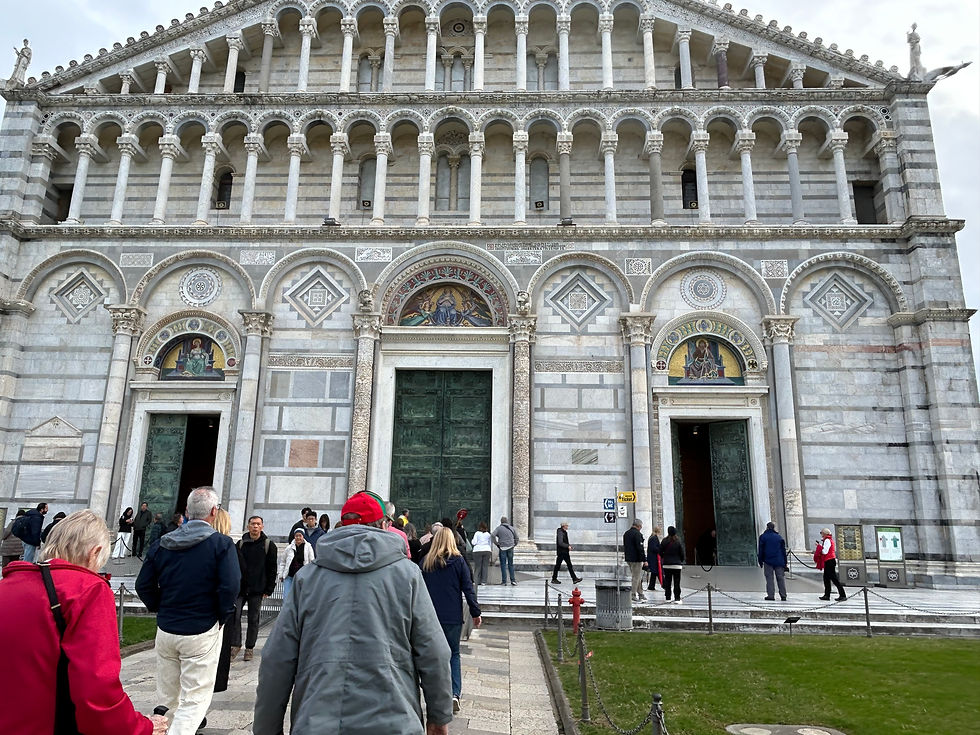
In 1595 the cathedral was badly damaged by fire, which melted the bronze doors. The expense was going to be much too great for restoration until Ferdinand I de’ Medici stepped in.


Here, besides the devil being cast out of heaven, on the far right you see an oddly shaped oval with round protrusions. That is the coat of arms of the Medici family.

The Medici family were bankers who ruled the Republic of Florence and the Grand Duchy of Tuscany from 1532 until 1737. They financed Saint Peter’s Basilica, the cathedral in Firenze, were patrons of Donatello, Botticelli, Leonardo da Vinci, Michelangelo, Raphael, Machiavelli, and Galileo, and were among the first businesses to use the double-entry bookkeeping system.

The famous Leaning Tower settled in the soft earth causing it to lean 5.5 degrees. That may not sound like much, but it is actually quite significant. In the late 20th century excavations were made, propping the tower up to its current 4 degree tilt. There is a spiral staircase up to the bells at the top. Sadly, tickets are required for the Duomo and Campanile, and although no ticket is required for the Baptistery one must schedule a time for entry. We were not given time for anything other than walking around the piazza (square) and taking pictures.

Glenn saving the day!
Even the traffic barriers are made of marble!


Pisa was the home of the astronomer Galileo Galilei and mathematician Leonardo Bonacci, known as Fibonacci.
We remained docked at Livorno for another day. I booked us for a day of cooking in a Tuscan castle! We drove past Firenze (Florence) and into the mountains to the 11th century Castello del Trebbio.

The castle‘s current owner’s father wanted a country home. The family started looking and stumbled upon this property. There is a lot of acreage, including grape vineyards and olive orchards. Her father loved the property, but his wife fell head over heels for the castle itself. The problem was that the castle was a wreck! Never mind, the price was right! After about six months they moved in following some renovations, but no bathrooms! They now make excellent wines, mostly chianti’s and extra virgin olive oil as well as running a restaurant. After we arrived we were given a tour of their wine cellars.

These barrels are enormous! Their Chianti Superiore is what I purchased and will be enjoying in Rome.

These are their absolute best wines. They test them each year to see if they are ready yet. Some are many decades old.
After a brief walk through some of the family’s rooms (no photos allowed) we went into the kitchen to meet Jerry, our Italian cooking teacher. We were to make the pasta and one of the sauces for our lunch.

Jerry had set up 2 stations for us. The mountain of flour was knocked down into a bowl shape and the eggs broken into it. Using forks the egg and flour began to be combined.

He added salt and some extra virgin olive oil, and once it was all combined the fork was retired and hands got involved. The dough was kneaded until it was no longer sticky, and when poked, returned to its original shape. It was then put to rest while the vegetable sauce was made. Olive oil, shallots, celery, carrots, just about any veg that you want, all chopped very small.

Notice that in the pan being stirred there is no tomato sauce. The Bolognese sauce requires many hours of cooking, so we only made the vegetable sauce.
Back to the pasta dough, with a little flour on the wooden board, the rolling pin was brought out and lots of rolling commenced. Getting the dough rolled out sufficiently takes a long time and a lot of turning the dough, stretching it, and making it thin and transparent.

Once the dough was sufficiently rolled out it was cut to size and boiled. Glenn tried his hand at cutting the dough. Everything was done by hand.
Our lunch consisted of antipasto, pasta with vegetable sauce, pasta with bolognese sauce and a biscotti. The antipasto was served with a very mild red wine, the pastas with a Chianti, and the biscotti with a dessert wine. I never knew that one dipped biscotti into wine! It was all very delicious. After a quick visit to the wine shop we headed back to the ship. A wonderful day!



The cooking class looks like so much fun! Believe it or not, I learned how to make pasta here in our little village in Colombia! A friend/owner of a restaurant held the class. It was great fun!