

Passau, Bavaria (oh yes, in Germany)
- Marjorie Monroe-Fischer
- Nov 1, 2024
- 3 min read

Thursday
This morning we arrived in Passau, a small town on the border with Austria. Our small group from the ship (those of us who needed to walk a little more slowly) joined a fantastic local guide and began to explore. Dieter shared that Bavaria had been independent for a very long time, and its residents consider themselves Bavarians first and Germans second.
History in this part of the world is bound together with religion. The Romans had conquered all of the area south of the Danube, pushing the Boii people across the river to Passau and beyond. In 739 the English archbishop Boniface founded the diocese of Passau, which for a very long time was the largest diocese in the greater Germanic area, even encompassing the very small village of Vienna. The area, like most of Europe below central Germany, has remained Catholic. Towns in the area are dominated with many church towers; the obvious sign of the many Catholic churches being the copper onion dome.

St. Stephen's Cathedral, seen here from the east end (the back) is a prime example. Here you see a little late gothic architecture, probably from the sixteenth century, but as you move around the narrow alley on the south side the building turns Baroque, the style beginning in 1600.

Inside, the Baroque period is more than obvious.

St. Stephen was a martyr who was stoned to death, c. 34 CE. Saul of Tarsus who later became the apostle Paul is said to have participated in the stoning. The statues above the centre of the high altar depict Stephen's death, while on the ceiling above, the fresco is said to depict his welcome into heaven. The ceiling fresco in the crossing of the cathedral has a wonderful painting of God, waving a welcome to all who enter.

Particularly special for me is the organ in the cathedral which is the largest in Europe.

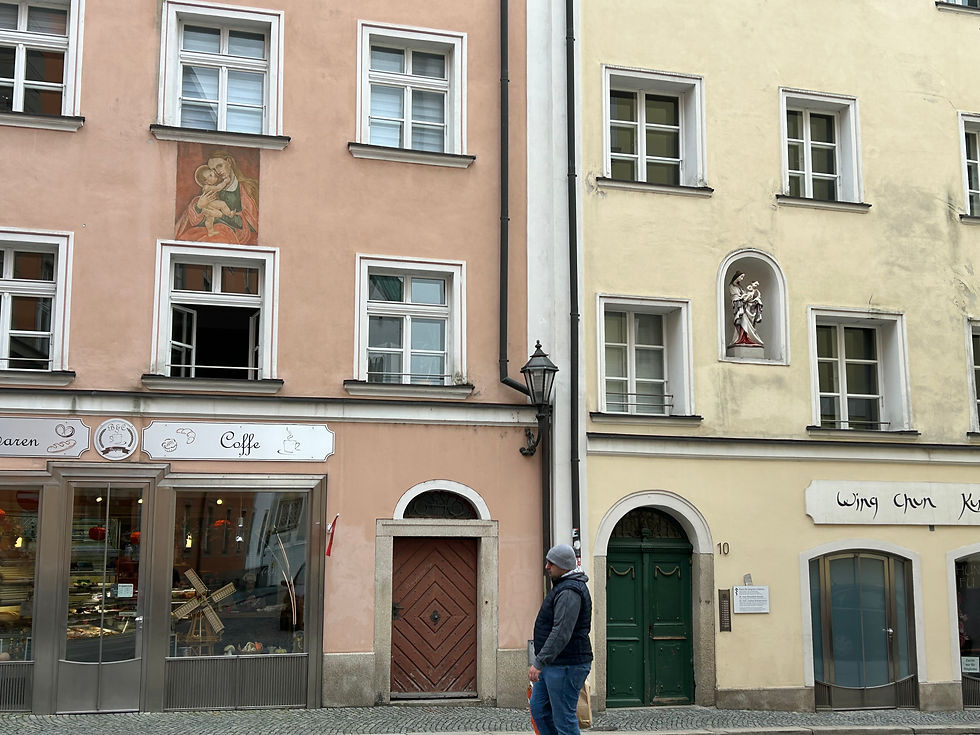
Many of the buildings have religious paintings or sculptures on them. These date from the middle ages, although they have been repainted. Their purpose was to ward off evil.

If only they warded off this terribly horrid sight. Graffiti has been absolutely everywhere on this trip, defacing just about everything that can be defaced. Thankfully, it has been removed from historic and important places.
Moving right along, Dieter told us a story about two boys who were playing along the south bank of the Danube. About five years old, these boys got a little rambunctious, and one started to fall into the river. Thinking quickly, the other boy grabbed and saved him. The saviour later became a bishop who deeply regretted saving his friend for the rest of his life. An odd thing for a bishop, don't you think? However, the friend's name was Adolf Hitler. The gray house in the centre of this photo is where the Hitlers lived while Adolf's father worked in the area as a customs agent for Austria.

A couple of things about Bavaria:
The streets are paved, for the most part, with cobblestones. No, that is not from Roman times! This paving probably dated from the 19th century. It is very tiring to walk on.
The buildings are all painted light pastel colours, usually with white trim.

While sailing on the Danube ships must go through many locks.

The ship is probably less than 18" from the wall of the lock!

Glenn leaned out, very slightly, of our window to take this photo. Watching the ship rise out of the blackness is fascinating.
In the evening we attended an Oktoberfest celebration! I think Glenn would look great in Lederhosen, don't you?



Comments