

Regensburg, Bavaria
- Marjorie Monroe-Fischer
- Nov 2, 2024
- 4 min read
Saturday
This morning we bid a fond farewell to the Gullveig, our new friends and Viking cruises. The trip was, for the most part, fantastic. We had a wonderful itinerary, great included shore excursions with local guides as well as really good extra excursions, excellent accommodations, wonderful service, delicious food - can you tell that we really enjoyed it? One thing that we felt could have been improved upon was the small number of informative lectures onboard, when that was an advertised benefit. The few that they did have were very good. One of our favourite onboard benefits was the dining staff so many of whom learned our names almost immediately and used them throughout the week, which is amazing considering there were a total of 190 passengers on board.

Efren and his wife Maggie were the greatest. Once when I was too tired for lunch Efren bundled up one of the fancy sweets and sent it back to the room with Glenn.
On with the real reason for the cruise, to visit these amazing places as well as see a couple of friends!
We actually arrived in Regensburg Friday morning and had a full day to explore. We had a very good local guide who had photos of some of the interesting places that we would see on our walk, which enhanced our understanding of what we were seeing. Ramona walked us around the old part of the city, pointing out historical details. Even with two days there, we missed things that we were interested in due to fatigue. We worked hard to build in rest throughout the week, but it was still a lot of activity, and we are not the healthiest sexagenarians on the block.
Let's get to the history. During the reign of Emperor Marcus Aurelius in 179 CE a Roman fortress, Castra Regina, was built. Check out the opening scenes of the film 'Gladiator.' It portrays a battle at this time and in this region. In the 6th century CE the fortress became the residence of the Dukes of the House of Agilolf, and was known as Reganespurc, probably the first appearance of the name. In the 12th and 13th centuries Regensburg was one of the wealthiest cities in the area, trading with places as far away as Paris and Venice. Architecture from this time can still be seen in the old part of the city.

This bridge across the Danube was built between 1135 and 1146, and was modelled after bridges which were built by the Romans. The fact that it stands today is a testament to the engineering of the Romans! It is now mostly a pedestrian bridge. The tower is one of the gates to the city, and the light coloured building next to it was a medieval warehouse for that priceless commodity, salt.
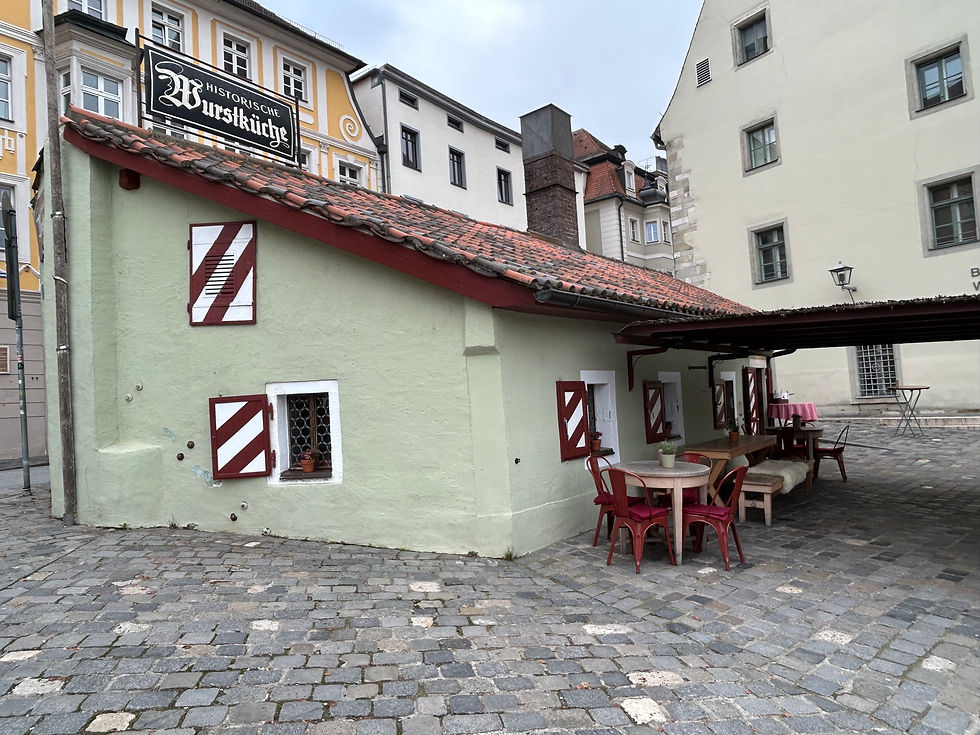
This small building on the other side of the salt warehouse is the Sausage Kitchen. It is possibly the oldest continuously open public restaurant in the world! The building was a construction office for the stone bridge, after which it became a restaurant called 'Garnkueche auf dem Kranchen,' which means 'cookshop near the crane.' It is still in operation. Here is the kitchen.

The building is located close to the Danube which floods quite regularly. Many buildings show high water marks from a variety of floods. To save this kitchen they flood it with clean water which keeps the dirty water from coming in. As the flood recedes they simply let the clean water push the dirty away.
During World War II the city was bombed, but miraculously on either side of the old part of the city, the ball-bearing factories on one side and the Messerschmitt factory on the opposite.
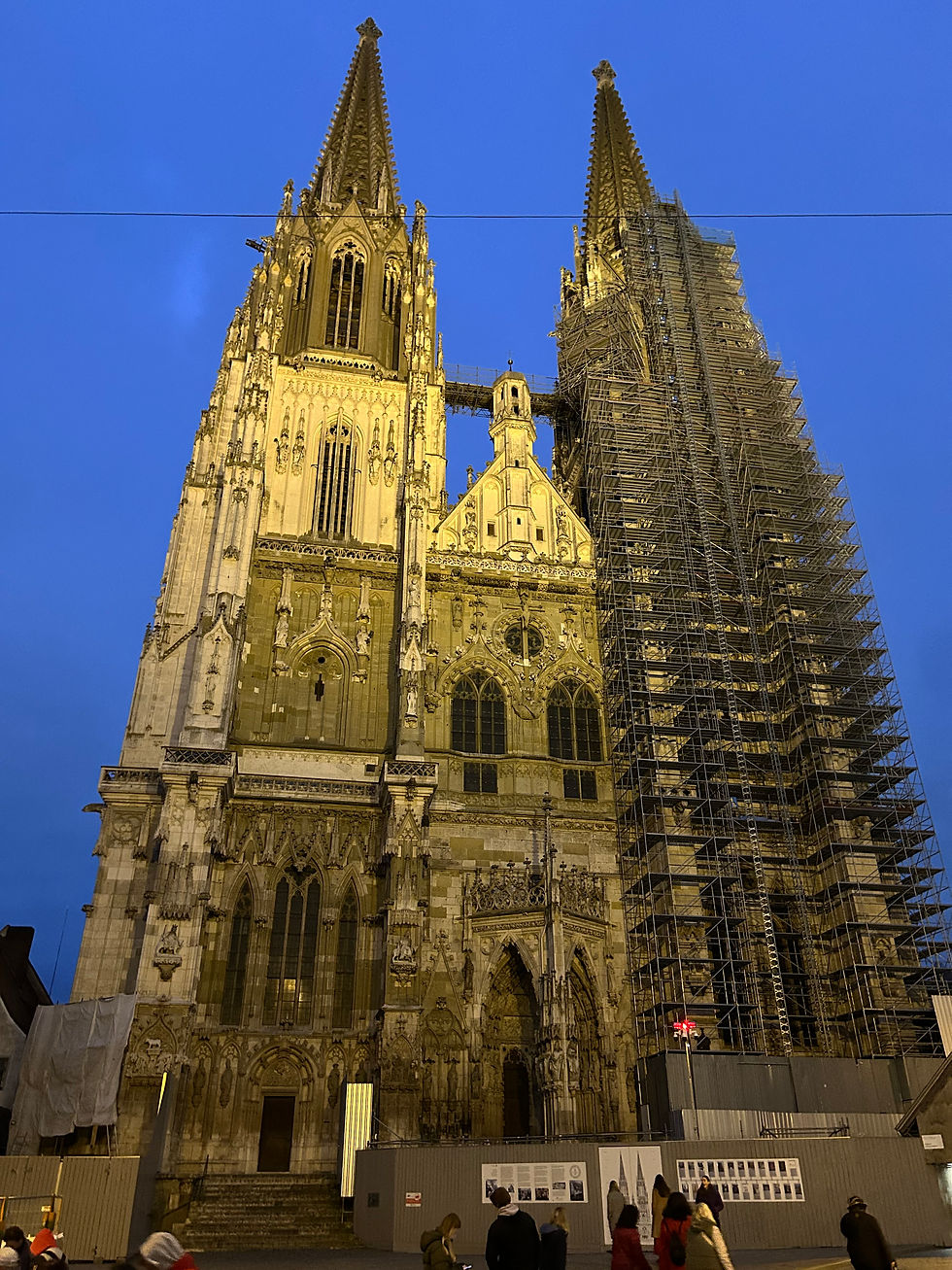
Regensburger Dom, otherwise known as St. Peter's Cathedral, dominates the city. The photograph at the beginning of this post is the cathedral just after dark. It sits across the square (which is not actually square) from our hotel. The original church on the site burned down in 1273. The cathedral was begun in 1280 by a French trained architect. It was finally completed when the twin towers of the west end were completed in 1869.

St. Peter's is actually very austere for a Catholic church in this area. It was fascinating to be able to explore it in relative peace. Another of the miraculous things about Regensburg in WWII was the fact that the people were forward thinking, and removed the stained glass before the area began to be bombed. Consequently, almost all of the stained glass is from the 14th century.

There are actually bits of the original paint in places on the stone walls. In the middle ages church walls and ceilings were covered with paintings. Spotting this bit was very exciting for me!

Is it possibly a depiction of the Last Supper? Perhaps if there had been more light in the cathedral I could have gotten a better picture. There were also roundels here and there which looked as though they were original.

This one is the hand of a priest in the act of blessing.
Another bit of stonework that I loved was the men holding up arches on the south wall. Each one was different.

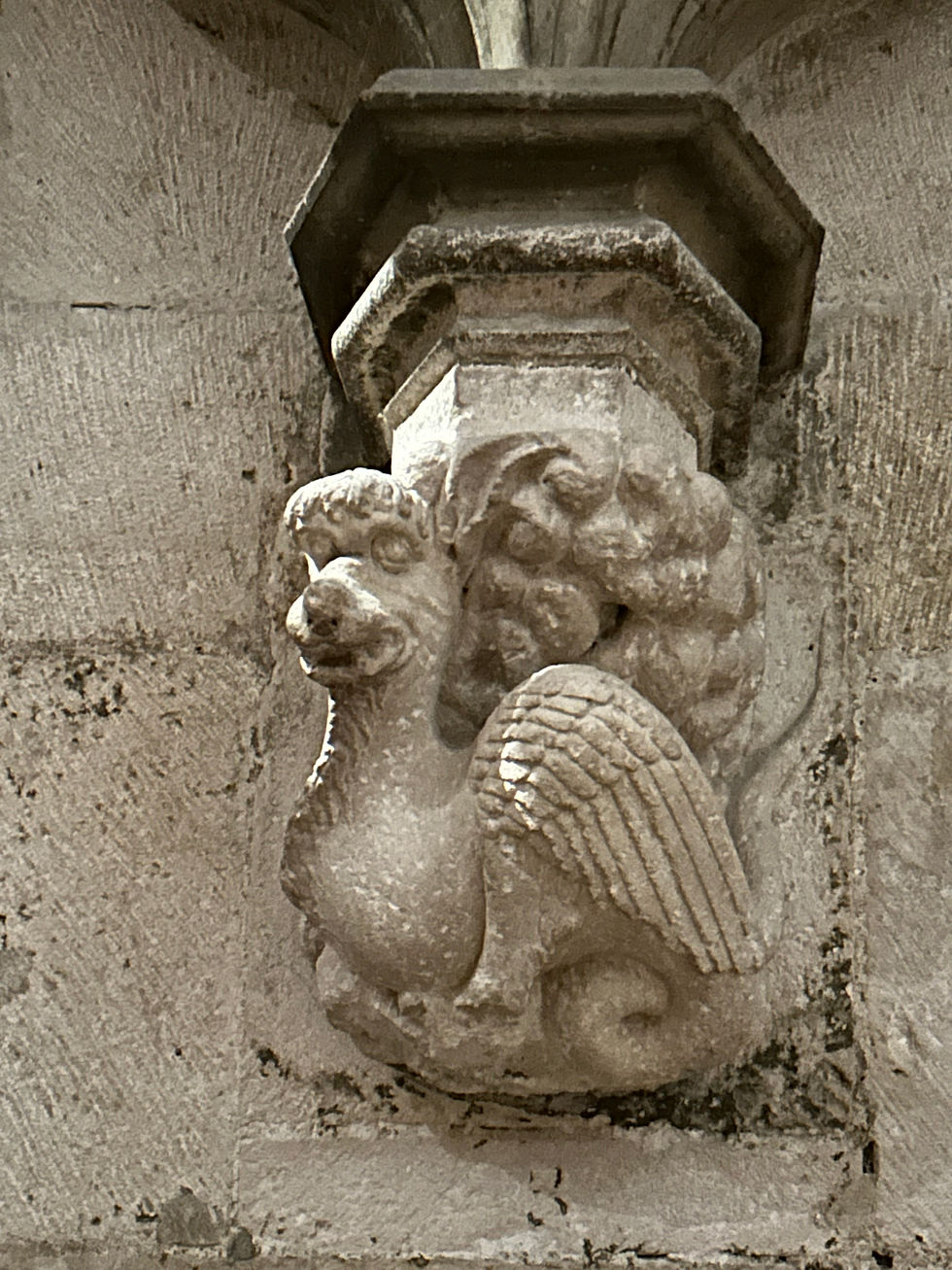
Is this a griffin???
And this - she is carrying a huge jug of liquid of some sort - and she is pregnant!

The city of Regensburg is now a UNESCO World Heritage Site.
Some final pictures:


And last but certainly not least, coffee with Viktor. He stayed with us for a week 25 years ago when he was accompanying some children from Chernobyl who were visiting the area for medical treatment as well as rest and fun.



Comments